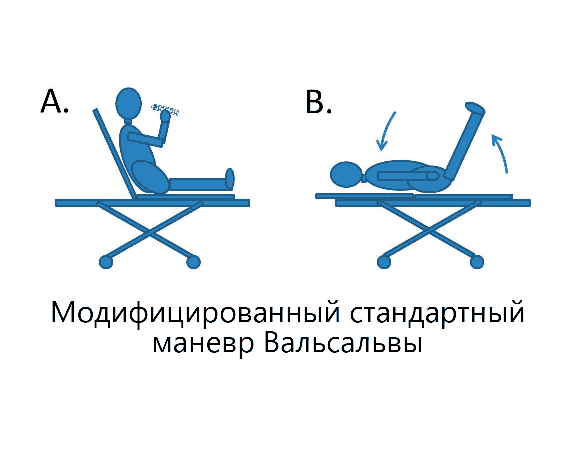
Modified Valsalva maneuver: an effective way to restore heart rhythm in supraventricular tachycardia.
Supraventricular tachycardia (SVT) is a condition in which the heart beats
too fast, which can cause discomfort and even serious complications. Various techniques
are used to restore normal rhythm, including the modified Valsalva maneuver.
This advanced maneuver significantly increases the chance of successful
treatment of the sufferer compared to the standard approach.
How to perform a modified
Valsalva maneuver?
The method includes three consecutive stages:
- Voltage.The
patient strains as if trying to exhale with the mouth closed and nose
pinched, or blows into the syringe, creating pressure. This strain should continue for
15 seconds.
- Lying position.Immediately
after the tension, the patient is quickly laid on his back and his legs
are raised at an angle of 45 degrees. He should remain in this position for 15 seconds.
- Return.The
patient returns to a sitting position, allowing the heart to adapt to the
change in blood flow.
Why does this work?
The modified Valsalva maneuver increases venous return of blood to the
heart. This causes activation of the vagus nerve, which slows the heart rate
through reflex mechanisms. This approach allows for the restoration of normal
heart rate without the use of medications.
Advantages of the method
- Efficiency.Studies
show that the modified method is 2-3 times more effective than the
standard Valsalva maneuver.
- Safety.The
procedure is completely non-invasive (without damaging the integrity of
the skin), which minimizes risks and makes it safe even when performed
independently (if recommended by a doctor).
- Availability.The
method can be used both in emergency settings and at home after
consultation with a medical specialist.
Important!
Although simple to perform, the Valsalva maneuver, even in a modified form,
should only be used after consultation with a physician. If symptoms of
supraventricular tachycardia (SVT) persist or worsen, seek immediate medical
attention.
The modified Valsalva maneuver is an innovative and affordable treatment
for supraventricular tachycardia that can provide significant relief and reduce
the need for medical intervention.