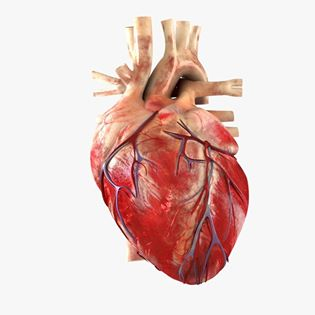
An amazing and unknown human heart.
The heart lives
in the future
A.S. Pushkin
The first information about
the structure of the heart is found in the ancient Egyptian papyrus “The Secret
Book of the Physician” (17-11th centuries BC - section “Heart, vessels of the
heart.”)
At least 30 - 35 centuries
have passed since then. And what do we (people) mean today in the concept of
heart?
Each branch of human knowledge
tends to define the heart in its own way:
Let's look at a few
definitions as an example:
Medicine:
Option 1: Heart- The central organ of the circulatory system in the
form of a muscle sac (in humans, on the left side of the chest cavity)
Option 2: The heart, cor,
is a hollow, four-chambered muscular organ that ensures the movement of blood
and lymph through the systemic, pulmonary and cardiac circulation.
Option 3: Heart- the central organ of the circulatory system of
animals and humans, pumping blood into the arterial system and ensuring its
return to the veins.
Psychological Encyclopedia:
(heart, cor) - a hollow,
cone-shaped muscular organ located between the lungs; its apex (apex) is
directed downward, forward and to the left. The size of the heart does not
exceed the size of a clenched fist...
Encyclopedia/aut.-state V.E. Baghdasaryan; I.B. Orlov; V.L.
Telitsyn
The HEART is a symbol of human
relationships, love between representatives of different sexes, life in general
- both physiologically and spiritually. The heart is a kind of barometer of a
person’s experiences, changes in his soul caused by external and internal
factors...
Bible Encyclopedia:The heart (Acts XVI, 14) is the seat of love, desires
and human affections. Therefore, to what extent can the heart be the guardian
of holy love for God and dispose a person to fulfill God’s commandments...
Many scientists tried to conduct additional research
in this area of the heart, the cost of which in the 70s of the 20th century
was more than the cost of astronaut flights to the Moon!
The heart was literally dismantled down to its
molecules, but the meaning of its true purpose in the human body was never
fully understood. So we haven't made much progress in 35 centuries of research
on this organ.
There are a number of incomprehensible facts that you
will not find in any physiology textbook.
So, some discovered facts that are the secrets of the
heart:
FACT: The capacity of all human vessels has a volume of
25-30 liters, and the amount of blood in the body is only 5-6 liters.
QUESTION: How is a larger volume filled with a smaller one? And
why such a design?
FACT: In a state of shock, when the patient’s blood pressure
drops to zero, in the carotid arteries it remains within normal limits - 120/70
mmHg. pillar
QUESTION: How does this happen and what is the meaning of this?
FACT: There is no mixing of blood elements in the body, but
a targeted distribution of its cells into separate streams depending on the
needs of each specific organ. Only old red blood cells are taken to the spleen
“for disposal”, and warm blood with a large amount of glucose, oxygen and young
red blood cells is sent to the brain.
QUESTION: How is the heart able to distribute blood where it
should for the needs of organs and systems? It turns out that the laws of
hydrodynamics simply do not apply here?
FACT: Cardiologists have recognized that the heart can be
reconstructed and replaced with a donor or even an artificial one. But! When a
heart is replaced with an artificial one, a donor one, or reconstructed,
forcing it into a clear rhythm, this often leads to chaos in the body, improper
blood flow, vascular thrombosis, and even gradual brain damage.
QUESTION: Why, because the blood continues to flow through the
vessels. What is wrong with its flow with an artificial rhythm?
FACT: the heart processes 2 × 10 (to the 15th power) units
of information in 1 second, which exceeds the speed of light -299,792,458 m/s!
QUESTION: Why does the heart need so much information and
where does the heart get this information, how does it react to it?
FACT: the heart learns about ionizing, gravitational,
temperature radiation, changes in pressure and the composition of the gaseous
environment long before our senses and consciousness perceive them. And
prepares the body for this expected effect.
QUESTION: How does it do this?
FACT: Differences have been discovered in human hearts after
death. Some hearts are filled with blood, others are completely dry. Research
has shown that when there is excess blood in a stopped heart, the brain and
other organs die because they are drained of blood, while the heart retains the
blood in itself, trying to preserve only its life. On the contrary, in people
who have died with a dry heart, not only is all the blood given to diseased
organs, but even particles of myocardium are found in them, which the heart
donated for their salvation.
QUESTION:Why does this happen, what is the physiological
meaning of this?
From this very short review it is clear that the
activity of the cardiovascular system does not obey the laws of physics! Thus,
in many ways the heart works according to laws still unknown to humans. What do
we call phenomena that occur according to laws unknown to science? We call all
phenomena that occur according to laws unknown to science MIRACLES!!!
This is information not only
for reflection, but also for reverence for HIM who created such an amazing
organ.
The more a person gets to know his heart, the more
blasphemous the idea will be for him that a person with his amazing heart is,
after all, a product of chance, that is, of evolution.